

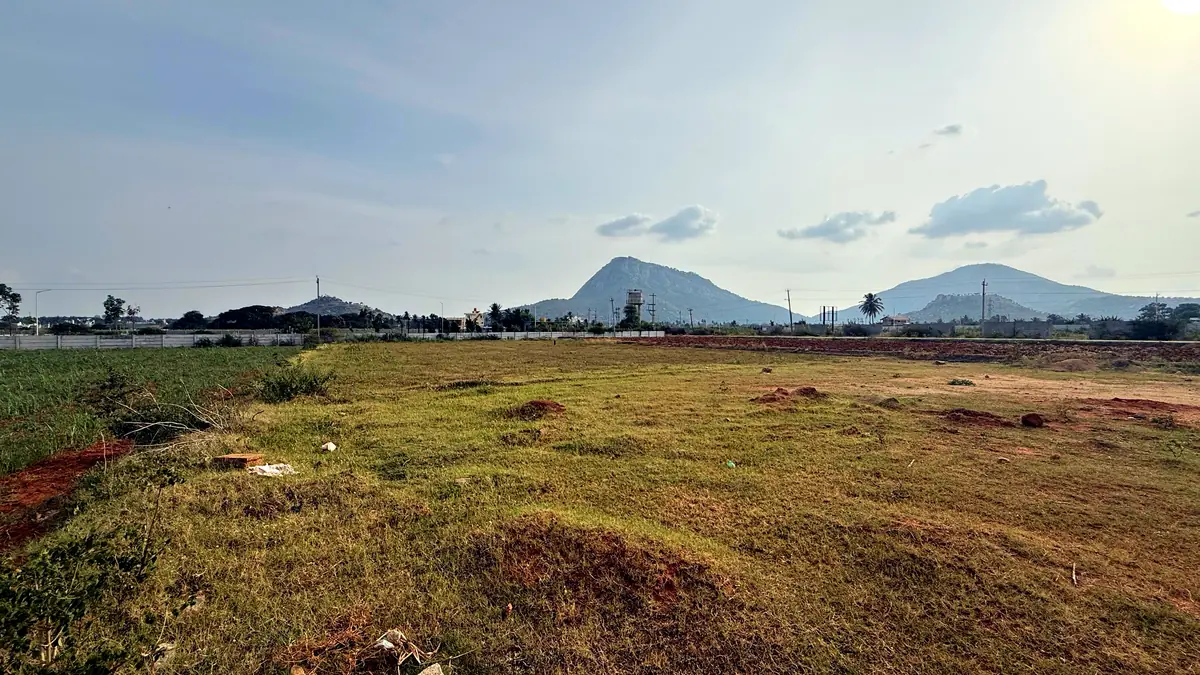
Farmland layout or converted plot: what you are buying
Two plots can look the same on a site visit and be different things on paper. One is agricultural land, sold as a farm plot. The other is land converted for housing, inside an approved layout. This note sets out what each one is and which record proves it. It is not legal advice.
A farmland layout
A farm plot is agricultural land. Its record is the RTC, also called the pahani, kept on the state's Bhoomi system. After the sale deed is registered, a mutation moves the land into your name on that record.
You may farm it. Building a home on it is a different matter. Any use other than farming needs conversion first. Check with your advocate what farm structures are allowed on your extent.
A converted plot
A converted plot began as farmland too. The Deputy Commissioner issues a conversion order under section 95 of the Karnataka Land Revenue Act. The order names the survey number, the extent and the new use.
A law firm's note of 17 November 2026 reports a rule change notified on 23 December 2025. Land inside a published master plan now needs no separate order where the use matches the plan. The fee goes to the planning authority with the layout application. Elsewhere the Deputy Commissioner still decides.
Conversion alone is not a layout. The planning authority must approve the layout plan. Each plot then gets its own khata: Form 9 and Form 11A on e-Swathu in a gram panchayat, or an e-khata in a town. Form 11B is only a tax entry for a property that does not qualify. It gives no title.
Where RERA fits
RERA registration is for a project that develops land into plots or apartments for sale. It needs the sanctioned layout plan and the approvals. A converted, approved layout larger than 500 square metres registers with K-RERA and carries a number you can look up.
A farmland layout has no sanctioned layout plan, so it carries no K-RERA number. We found no K-RERA order or Karnataka court ruling that settles the point. On 23 April 2024 the Bombay High Court said RERA governs only projects that must be registered. It gave a sale of agricultural land with no development as an example outside the Act. The word farmland does not decide it. What is developed and sold does. Check with your advocate.
Who can buy
Since the 2020 amendment to the Karnataka Land Reforms Act, a buyer need not be a farmer and there is no income limit. A ceiling on total holding remains: 10 units for a person or a family of up to five. Land once granted to Scheduled Caste or Scheduled Tribe families carries its own restrictions.
A non-resident Indian or an Overseas Citizen of India cannot buy agricultural land or a farmhouse under the foreign exchange rules of 2019. They may inherit it. They may buy a converted plot.
Small farm plots: one more check
A circular reported in February 2026 tells Deputy Commissioners to reject conversion for agricultural plots of 5 guntas or less, about 5,445 square feet. The same reports say the 11E survey sketch for so small a piece is allowed only once, for a family partition. We have not seen the circular. If the plot on offer is smaller than that, ask how it will get its own sketch, mutation and RTC. Check with your advocate before you pay.
What to ask for
The figure a seller or a portal quotes for either kind is an ask. Compare asks only between plots of the same kind.
- Farm plot: the RTC, the mutation extract, the encumbrance certificate, the survey sketch (with the 11E or phodi sketch for part of a survey number) and a granted-land check.
- Converted plot: the conversion order or the planning authority's fee receipt, the approved layout plan, Form 9 and Form 11A or the e-khata, the encumbrance certificate and the K-RERA number.
- Both: the seller's title deeds, and a road to the plot on paper as well as on the ground.
Asked about this
Is a farmland layout registered with K-RERA?
Usually not. It has no sanctioned layout plan to register. Whether RERA applies to a scheme turns on its facts. Check with your advocate.
Can an NRI buy a farm plot?
No. The foreign exchange rules of 2019 bar an NRI or OCI from buying agricultural land or a farmhouse. Inheritance is allowed.
Is stamp duty different for a farm plot?
No. Both kinds pay 5% stamp duty, in force since 1 April 2012, plus cess, surcharge and the 2% registration fee that began on 31 August 2025.
Sources
- Bombay High Court, Mohammed Zain Khan v. Emnoy Properties India LLP, Second Appeal 209 of 2022, 23 April 2024: quotes sections 2(zn), 3 and 4 of the Real Estate (Regulation and Development) Act, 2016 (copy on Indian Kanoon)
- Karnataka Land Reforms (Second Amendment) Ordinance, 2020 (Ordinance 23 of 2020): sections 79A, 79B and 79C omitted from 1 March 1974; sections 80 and 80A (copy on LegitQuest)
- Deccan Herald, 3 November 2020: second ordinance keeps the land ceiling at 10 and 20 units
- Verdictum, 26 August 2025: Supreme Court in R Raghu v. G M Krishna, 2025 INSC 1040, on the repeal of sections 79A to 79C
- Reserve Bank of India, FAQ on purchase of immovable property in India by NRIs, OCIs and foreign nationals (updated 6 April 2023): Foreign Exchange Management (Non-debt Instruments) Rules, 2019, rule 24
- Cyril Amarchand Mangaldas note carried by Conventus Law, 17 November 2026: land conversion inside master plan limits, Karnataka Act 25 of 2023 and the rules of 23 December 2025
- One City Property, updated 30 August 2026: what a conversion order under section 95 contains
- Mercatus Center, Reforming Agricultural Land Conversion Laws in States (updated 10 May 2026): Karnataka conversion inside and outside master plan areas
- Propheadlines, 8 March 2026: circular against conversion of agricultural plots of 5 guntas or less
- Ghar.tv, 12 March 2026: the same circular and the 11E sketch
- Homesok, 24 July 2026: e-Swathu, Form 9, Form 11 and Form 11B for gram panchayat property
- BangaloreProp, 13 October 2026: Form 9, Form 11A and Form 11B, and the 2025 amendment to the Panchayat Raj Act
Read next
Send us the survey number or the project name. We answer with the papers, in writing.
WhatsApp the desk